What Is a CPU? A Beginner-Friendly Guide
What Is a CPU?
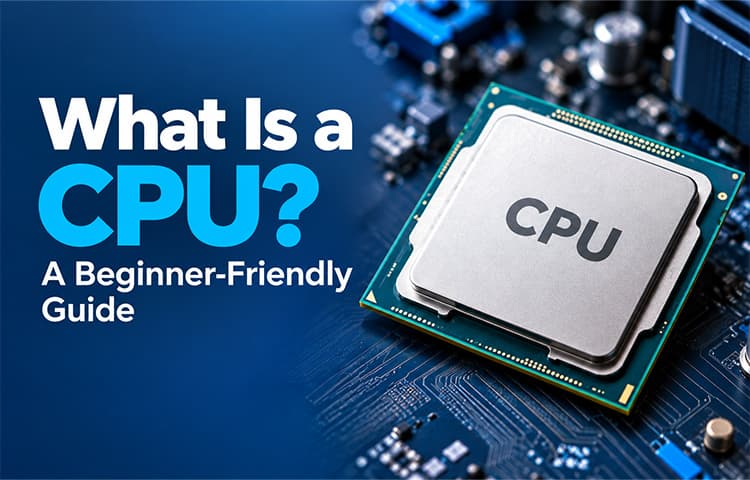
A CPU, short for Central Processing Unit, is the main chip inside a computer that carries out instructions. It helps run your apps, load websites, open files, play videos, and respond when you click, type, or tap. People often call the CPU the “brain” of the computer because it makes decisions and coordinates many of the things your device does. If your computer is a symphony, then the CPU is the conductor, orchestrating the flow of data through your system. And the more powerful the CPU, the more efficiently that data and the amount thereof can be processed within a microsecond.
What Does a CPU Actually Do?
At the most basic level, a CPU follows instructions. Those instructions come from software, such as your web browser, operating system, games, or office apps. The CPU reads each instruction, understands what it means, performs the needed action, and then moves on to the next one. This happens incredibly fast, often billions of times per second. Every mouse click, every keystroke, every pixel currently on your screen is because of the CPU. It’s a lot to handle, which is why delegation of tasks to different components like the GPU or other external units can help free up the CPU to do it’s primary task of controlling data flow.
The Basic CPU Cycle
CPUs work through a repeating process often described as fetch, decode, execute, and store. First, the CPU fetches an instruction from memory. Next, it decodes the instruction so it knows what to do. Then it executes the instruction, such as adding numbers or moving data. Finally, it stores the result so the computer can use it.
Important CPU Terms Explained Simply
- Core: A core is like a worker inside the CPU. More cores can help a computer handle multiple tasks at once.
- Clock speed: This measures how quickly a CPU can work through instructions. It is often listed in gigahertz, or GHz.
- Cache: Cache is a small amount of very fast memory built close to the CPU so it can quickly access information it uses often.
- Threads: Threads are task pathways that help a CPU manage work more efficiently, especially when many things are happening at the same time.
Why the CPU Matters
The CPU affects how responsive a computer feels. A stronger CPU can help with multitasking, video calls, spreadsheets, gaming, coding, and creative work like editing photos or videos. If your system is experiencing any performance-related hiccups or overall slowness, then odds are the CPU is being throttled and needs support from other components to be able to perform at optimal settings.
How to Think About CPUs When Buying a Computer
If you mainly browse the web, write documents, and stream videos, you probably do not need the most powerful CPU available. If you edit videos, play demanding games, run business software, or keep many apps open at once, a faster CPU with more cores may make a noticeable difference. The best CPU depends on what you actually do with your computer.
The Bottom Line
The CPU is the part of a computer that reads instructions, makes decisions, and keeps software running. You do not need to understand every technical detail to understand the basic idea: when your computer does something, the CPU is usually one of the main parts helping make it happen.


What goes into our Building Standards